The 10-Point Institutional Platform Stress Test
In the current market, the difference between a firm that scales and one that stagnates is not just the quality of its Alpha. It is the resilience of its architecture.
For years, I have audited firms that believe they are ready for growth, only to find they are running on Manual Heroics. This is a culture where talented people work late into the night to fix trade breaks and reconcile spreadsheets. It works for a while, but eventually, the operational debt comes due.
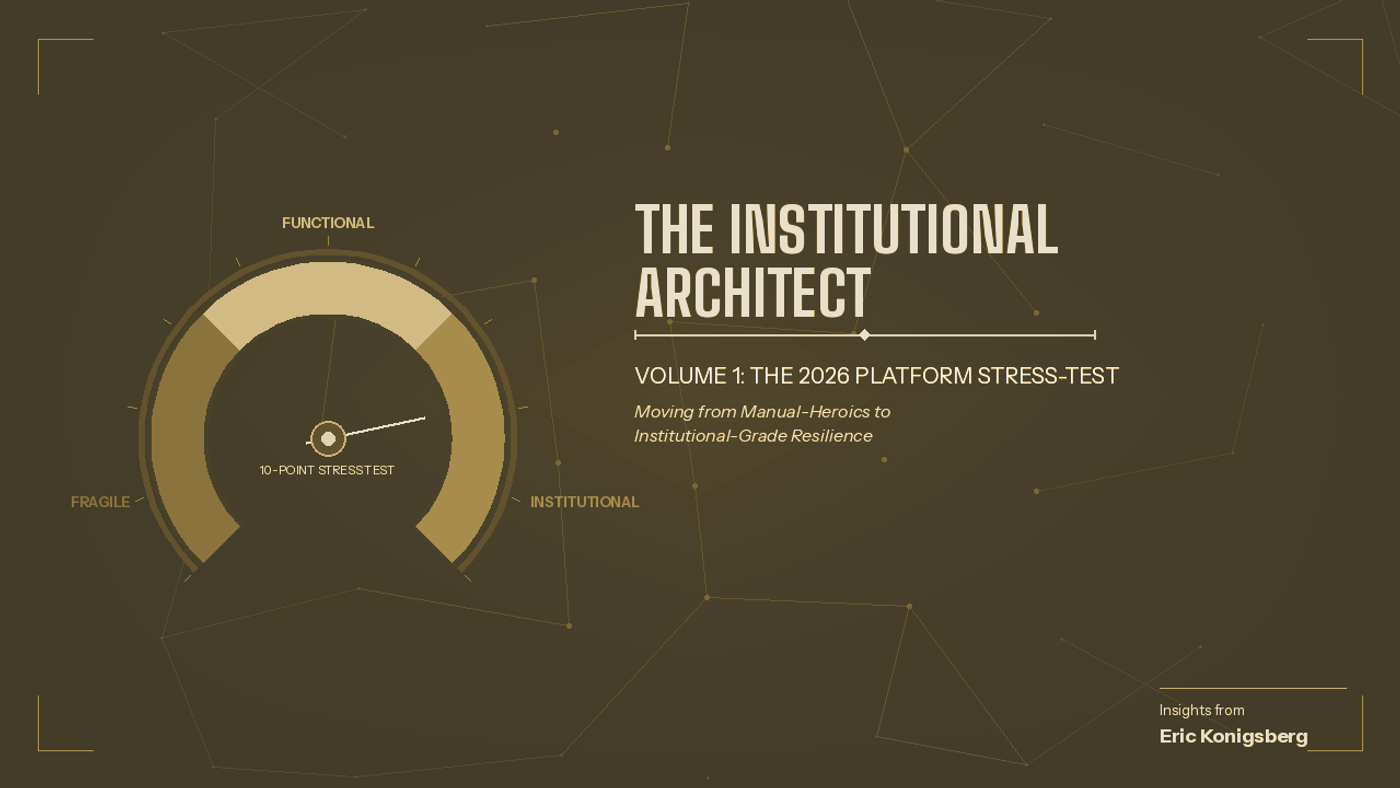
I developed this 10-Point Institutional Platform Stress Test to help COOs, Principals, and Founders move from a Fragile state to institutional-grade resilience.
The Diagnostic
Rate your firm honestly against these 10 markers of institutional maturity:
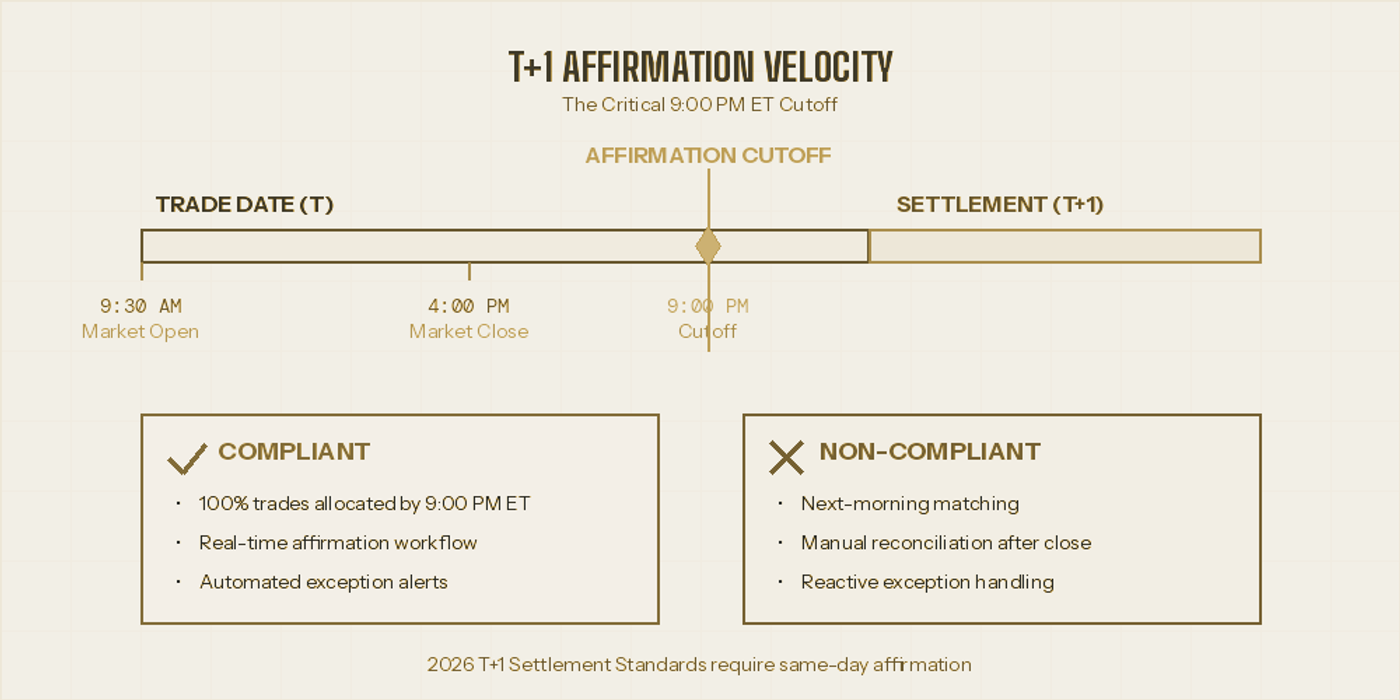
- T+1 Affirmation Velocity: Verify that 100% of trades are allocated and affirmed by the 9:00 PM ET cutoff on Trade Date (T). If you rely on next-morning matching, your platform is structurally non-compliant with 2026 standards.
2. Data Lineage and Golden Records: Establish if every data point in your reports is traceable to a single verified source or if teams are reconciling shadow spreadsheets to stay afloat.
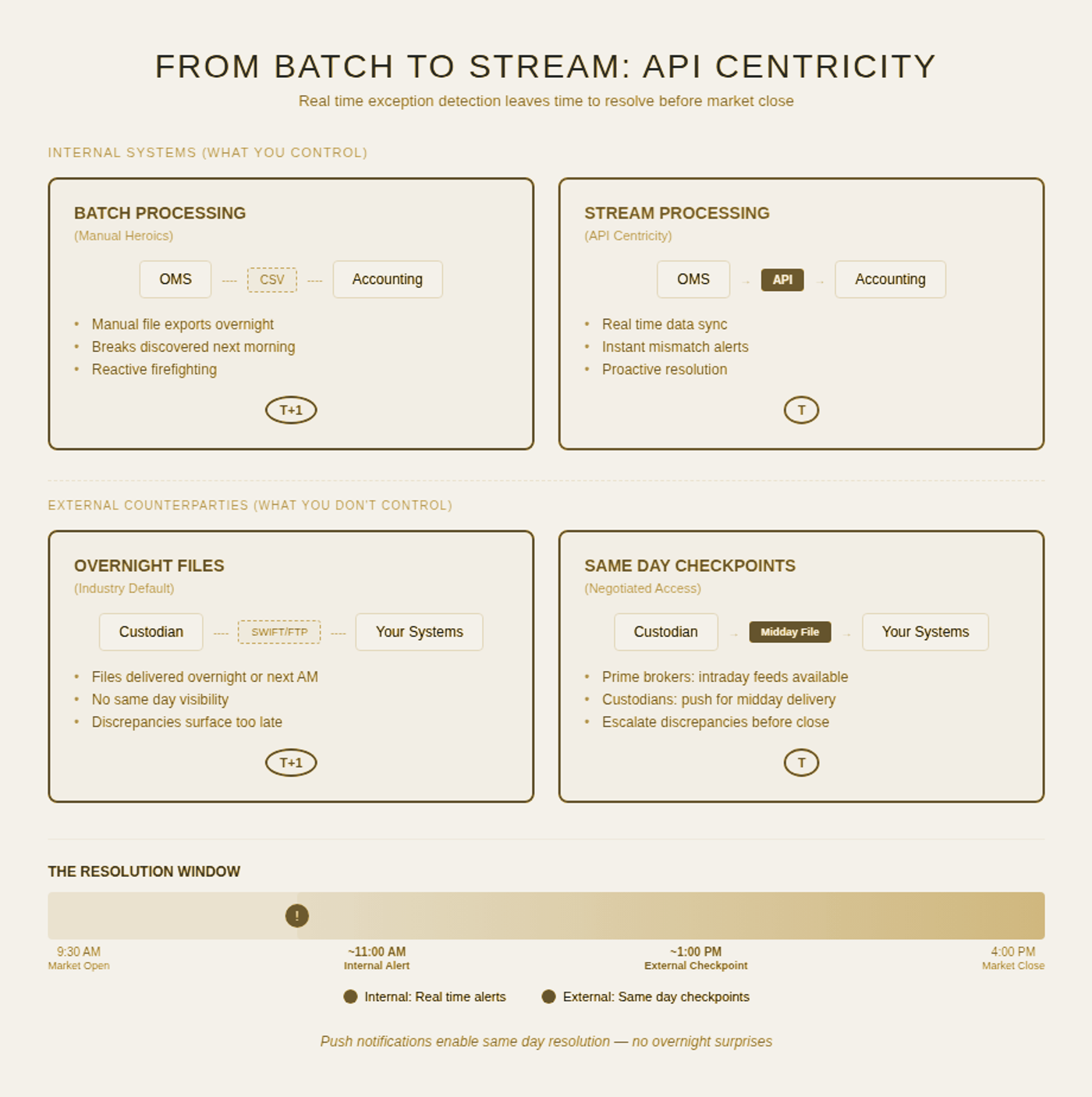
3. Intraday Exception Management: Judge whether you have real-time visibility into what you control (trade allocation, internal booking, prime broker positions) and same-day checkpoints against what you don't (custodians, administrators). If your first line of defense is an overnight file, your platform is structurally exposed under T+1.
THE ARCHITECT’S NOTE: For internal systems (OMS, EMS, and your book of record), true real-time is achievable today through API Centricity. Link them via APIs and create a push notification environment so that if an allocation does not match a trade ticket, your team knows within minutes. For external counterparties, the goal is structured same-day checkpoints. Prime brokers increasingly offer intraday position feeds; custodians and administrators are further behind but can deliver midday files if you push for them. The principle remains: resolve what you can by 2:00 PM ET, escalate external discrepancies before the 4:00 PM close, and never let the first alert come from an overnight batch report.
4. Unstructured Data Ingestion: Assess if you are using human capital to manually read subscription agreements or if you have an automated process to extract mandates in minutes.
5. Incident Response and Black Swan Resilience: Establish if your firm has a rehearsed tactical playbook for operational Black Swan events or if your Business Continuity Plan (“BCP”) is simply a compliance document.
6. AI Readiness and Factuality: Review your human-in-the-loop framework for validating AI outputs to ensure institutional-grade reliability. Automation without disciplined validation is a risk, not a solution.
7. The Single Point of Failure (SPOF) Audit: Confirm if your processes are documented sufficiently for a new hire to execute a full trading cycle without disruption should a key operations or technology lead depart unexpectedly.
8. Implementation Leakage: Verify if investment constraints and IPS mandates are hard-coded into your Order Management System (“OMS”) platforms to prevent manual compliance failures.
9. Bespoke Scale for Multi-Family Offices: Judge whether your platform can support the bespoke reporting and entity tracking requirements of a billion-dollar mandate without requiring incremental headcount.
10. Vendor and Financing Optimization: Analyze when you last stress tested your financing costs and margin utilization across prime brokers to identify potential carry leakage.
Scoring Your Platform
- 8 to 10 Points: Institutional Grade. Your platform is an asset that drives enterprise value.
- 5 to 7 Points: Functional. You have friction costs that are likely hampering your Alpha.
- Below 5 Points: Fragile. You have significant operational debt that poses a risk to the firm’s reputation.
The Path Forward
A score of Fragile or Functional in any category represents a ceiling on your AUM growth. These gaps are rarely solved by adding more people. They require an architectural shift from manual processing to intelligence architecture.
I will be performing a deep dive into each of these points in my weekly LinkedIn series, The COO’s Perspective. Each month, I will synthesize those insights here in The Institutional Architect to provide a permanent roadmap for your platform's evolution.
Where does your firm stand? Let us build a roadmap to move your platform toward Institutional Grade.
Subscribe to stay updated on each deep dive.
#COO #AssetManagement #FamilyOffice #OperationalExcellence #FinTech #InstitutionalArchitect
Want the diagnostic frameworks behind these notes?