The Velocity Gap
In the post-T+1 market, “on-time” is no longer a matter of opinion; it is a mathematical requirement. Since the May 2024 mandate, the window for error has effectively vanished. To navigate this successfully, a platform must optimize for AFFIRMATION VELOCITY.
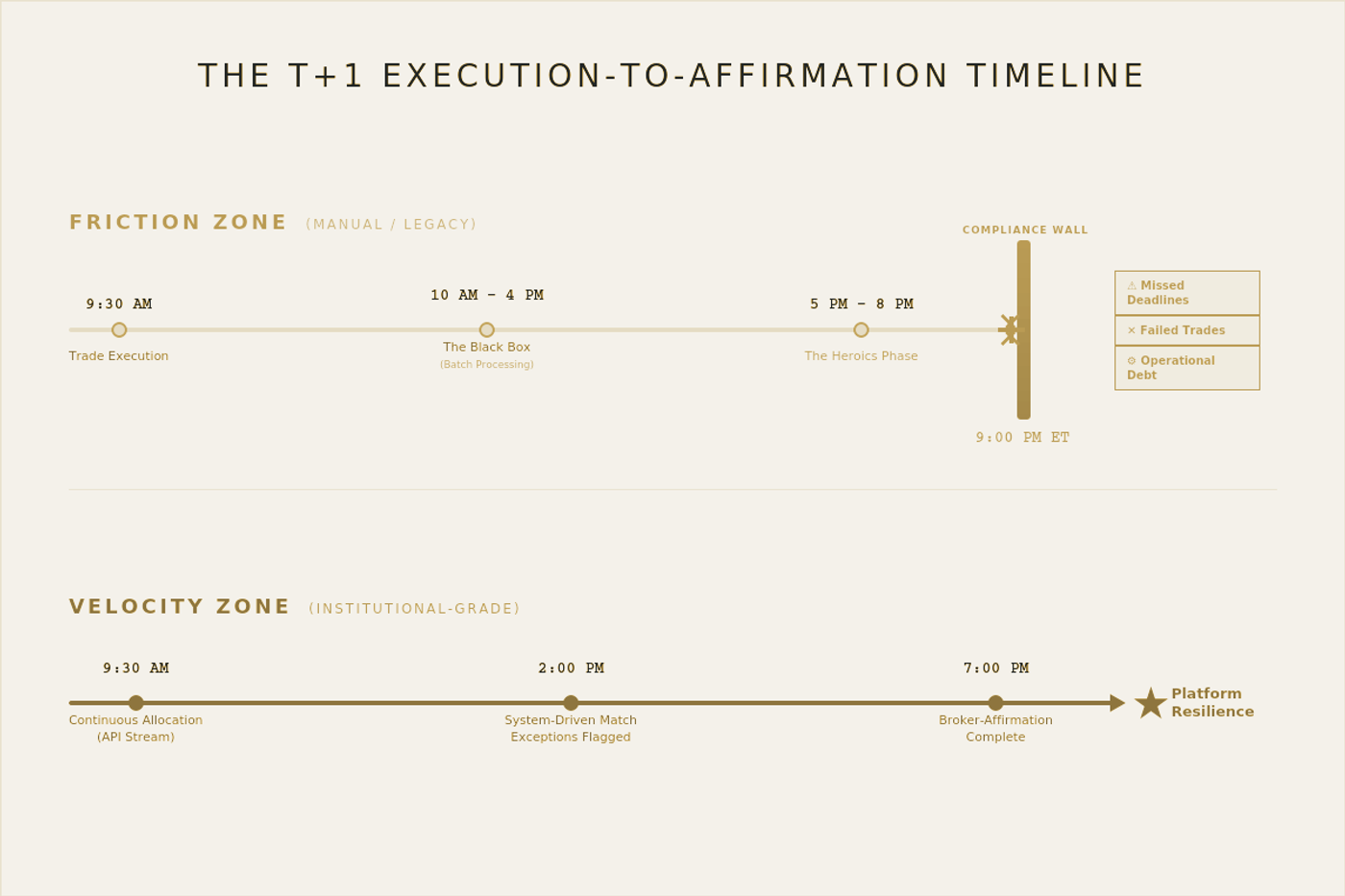
DEFINING VELOCITY: It isn’t just about fast execution; it’s the speed at which a trade is legally affirmed by all parties. In a high-velocity model, this happens by 2:00 PM ET on Trade-Date (T). In a low-velocity model, matching drags toward 9:00 PM, creating a "Heroics Trap" of manual intervention and late-night firefighting.
THE 9:00 PM BASELINE
The 9:00 PM ET broker affirmation cutoff is the hard wall. To clear it consistently, we must move from manual effort to institutional-grade architecture.
THE ARCHITECT’S SOLUTION FOR T+1:
- Continuous allocation: Automating the trade-to-allocation flow so it moves in minutes, not hours.
- Live API streams: Replacing batch processing with real-time streams to flag exceptions while markets are still open.
- The diagnostic milestone: Setting an internal "clean" deadline of 2:00 PM to ensure exceptions are resolved before the regulatory wall hits.
INTELLIGENCE ARCHITECTURE: THE PREDICTIVE EDGE
True velocity demands predictive visibility. Layer AI-powered exception prediction to flag allocation mismatches by 1:00 PM ET, well before formal matching begins, turning the 9:00 PM deadline into a routine checkpoint, not a crisis.
Post-T+1, industry analyses from DTCC show that affirmation rates reach 95%+ through such automation, while Broadridge highlights up to 50% reductions in manual effort via real-time detection and resolution. With human oversight, this scales resilience without burnout.
THE STAKES: BEYOND THE BACK-OFFICE
Failing to make this shift creates Board-level risks I call "platform leakage":
- Fiduciary drag: Increased margin requirements and failed-trade penalties directly erode fund performance.
- Reputational contagion: Prime brokers rank firms by "settlement alpha." Chronic delays put your firm on watch lists.
THE PATH FORWARD
True platform resilience comes from a Stream-Advantage model. By the time the sun sets, your trades should be "put to bed." We are moving from reactive firefighting to near-zero-touch processing.
I have shared the full 10-point Platform Maturity Audit in my newsletter, "THE INSTITUTIONAL ARCHITECT." Access the Institutional Platform Stress-Test here: https://lnkd.in/eBSuvMhb
POLL: Where is your biggest 9:00 PM bottleneck? 👍 Internal Systems 👏 Vendors ❤️ Handoffs 💡 Strategy/Governance
Drop a reaction in the comments.
NEXT WEEK: The Shadow Spreadsheet Problem.
📊 THE TIMELINE DIAGNOSTIC: Resilience vs. operational debt comes down to time. Goal: Move the diagnostic milestone to 2:00 PM to resolve exceptions before the 9:00 PM ET Compliance Wall.
#COO #FamilyOffice #T1Settlement #OperationalExcellence #FinTech #AIinFinance #AssetManagement
<span class="mark">FIRST COMMENT</span>
Here are the primary sources for the DTCC and Broadridge data mentioned above regarding T+1 affirmation trends and automation efficiency:
🔗 DTCC T+1 Affirmation Trends: https://live-sifma-new.pantheonsite.io/wp-content/uploads/2024/09/T1-After-Action-Report-FINAL-SIFMA-ICI-DTCC.pdf
🔗 Broadridge Operations & Automation Analysis: https://www.broadridge.com/white-paper/capital-markets/efficiency-unleashed-capital-markets-operations-reimagined-with-generative-ai
The data confirms that the gap between "Manual Heroics" and "Institutional Architecture" is only growing. How is your firm pacing against these industry benchmarks?
Want the diagnostic frameworks behind these notes?