The IPS Gap
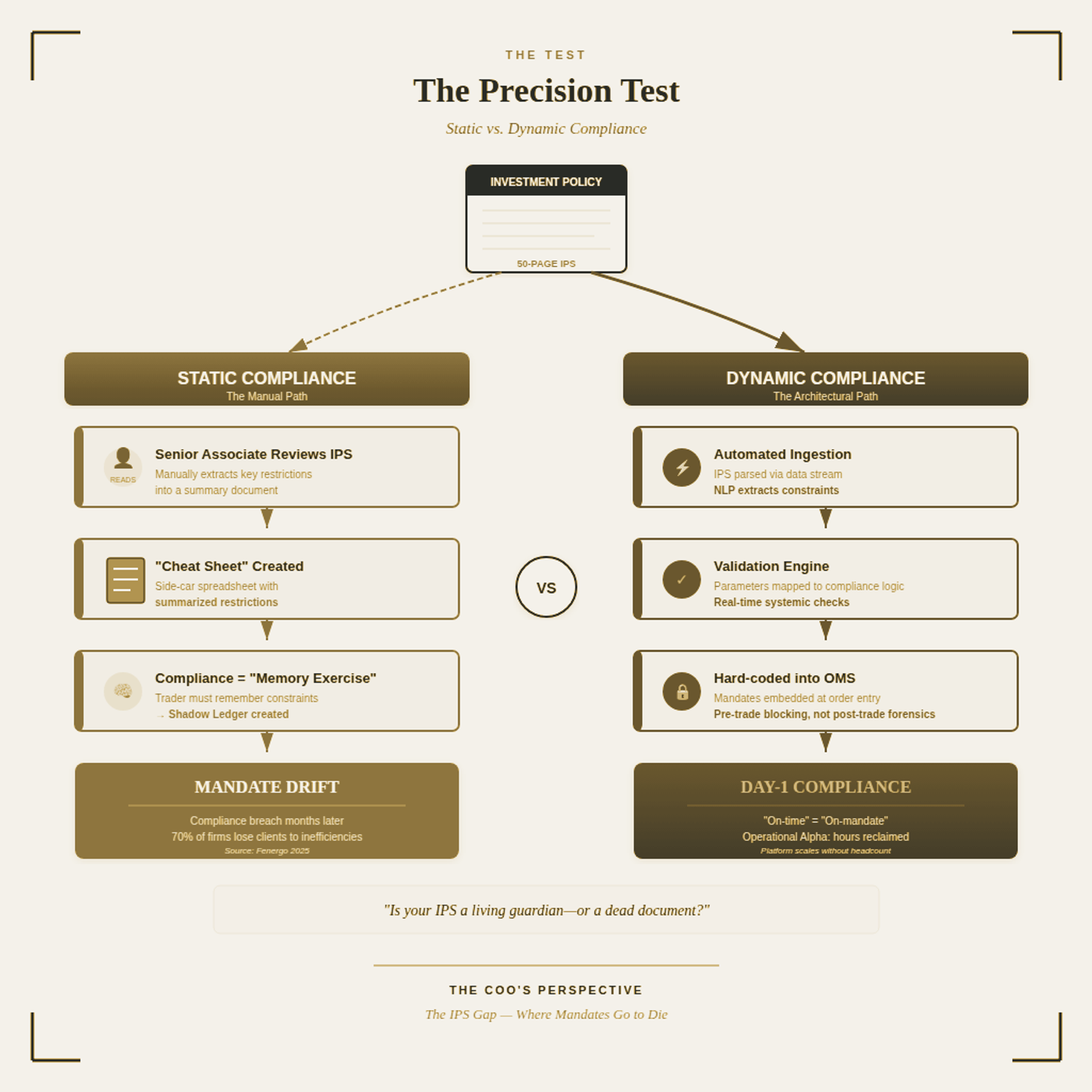
The most dangerous gap in an institutional platform is the distance between a legal mandate and the Order Management System (OMS).
When a bespoke Investment Policy Statement (IPS) is treated as a "document to be read" rather than "data to be ingested," your platform is suffering from Implementation Leakage. Heroics mask this operational debt, but the IPS-to-OMS gap is where that debt becomes measurable, eroding alpha before the first trade is even placed.
THE PRECISION TEST: STATIC VS. DYNAMIC COMPLIANCE
Heroics treat symptoms. The IPS gap reveals the root cause: Mandate Drift
- Manual Path: A senior associate reads a 50-page IPS and summarizes key restrictions into a "Cheat Sheet" or a sidecar spreadsheet.
- Risk: This creates a Shadow Ledger. Compliance becomes a "memory exercise" for the trader, leading to the hard-coding of future reconciliation breaks or, worse, a multimillion-dollar mandate breach.
- Architectural Path: The IPS is ingested via an automated data stream, where parameters such as concentration limits, ESG exclusions, and liquidity ladders are validated and mapped directly to the compliance engine.
THE ECONOMIC REALITY: PROTECTING THE AUM
Industry benchmarks from Deloitte and Fenergo benchmarks show onboarding costs \$20K–\$30K per client, but the true cost is attrition.
Nearly 70% of institutions report losing clients due to these early-stage inefficiencies. In a post-T+1 environment, you cannot afford a "Spreadsheet Bridge" to translate complex intent into rapid execution. If you cannot prove Day One compliance, you are not just losing a client; you are failing a fiduciary test.
LOOKING AHEAD: THE INTELLIGENCE PHASE
To move from "Heroics" to "Architecture," we must bridge the mandate-to-code gap. Over the next month, we will enter the Intelligence Phase, where we will dive into the technical execution of:
- Ingestion: Moving beyond text scanning to the automated extraction of rules from unstructured legal documents
- Validation: Systemic checks against compliance logic in real-time.
- Governance: Embedding mandates into the OMS to ensure "on-time" execution is also "on-mandate" execution.
THE STAKES: OPERATIONAL ALPHA
Plugging these leaks creates Operational Alpha. By implementing an Intelligence Architecture, you reclaim senior talent from the drudgery of "Spreadsheet Bridges," freeing them for strategy and risk oversight.
Your platform scales without linear headcount increases because your architecture, not your staff, is the guardian of the mandate.
📊 THE LEAKAGE AUDIT: Is your IPS a "living guardian" or a "dead document"? Access my 10-point diagnostic in the newsletter, "THE INSTITUTIONAL ARCHITECT": https://lnkd.in/eBSuvMhb
NEXT WEEK: We conclude "The Foundations" and begin the Intelligence Phase with a look at Batch vs. Stream processing.
#COO #AssetManagement #FamilyOffice #OperationalExcellence #FinTech #OMS #AIinFinance
<span class="mark">\[FIRST COMMENT\]</span>
Here is the primary source for the onboarding data referenced above:
🔗 Deloitte Digital Client Onboarding Research: https://www.keesystem.com/compliance-risk/how-to-deploy-digital-client-onboarding-in-wealth-management/
Additional multisource:
🔗 Fenergo 2025 Trends Report: https://resources.fenergo.com/newsroom/global-financial-institutions-struggle-with-rising-client-losses-and-compliance-costs-as-ai-adoption-increases-fenergo
🔗 McKinsey on Corporate Onboarding: https://www.mckinsey.com/industries/financial-services/our-insights/winning-corporate-clients-with-great-onboarding
The data confirms that Implementation Leakage (and the resulting client attrition) starts long before the first trade. Firms that bridge the IPS-to-OMS gap aren't just saving on administrative costs—they are protecting their AUM.
Want the diagnostic frameworks behind these notes?