The 120-Minute Window
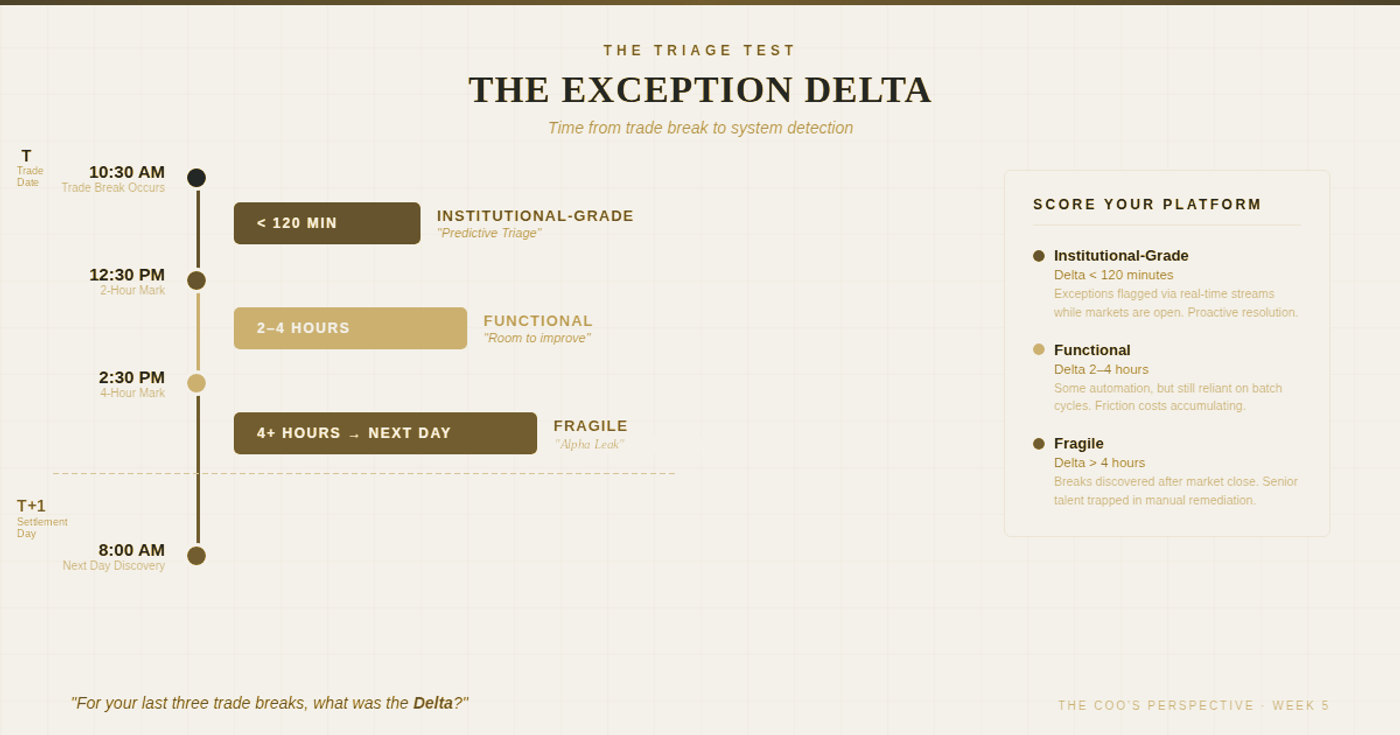
If you are identifying a trade break at 6:00 PM, you aren’t managing risk; you’re just diagnosing a failure.
The industry celebrates a 95% affirmation rate as a T+1 victory. For the COO, the real story is in the other 2.12%. According to the DTCC/SIFMA After-Action Report, the remaining Continuous Net Settlement (CNS) failure rate points to persistent friction that quietly erodes margins. In a \$1T+ daily equities market, those tail failures add up to billions in industry-wide costs each year through penalties, forced buy-ins, and operational drag.
To capture Operational Alpha, we must break the Batch Death Spiral: the architectural lag that renders your risk management reactive rather than proactive.
THE MATH OF THE LAG To manage a modern platform, you must measure Architectural Velocity through a formal KPI: The Exception Delta—the elapsed time between when an error occurs and when your system systemically detects it.
FROM ADMINISTRATIVE FIX TO ALPHA LEAK The 120-minute window is the "point of no return."
- Inside the Window (T, Pre-Settlement): A trade break discovered at 10:30 AM on Trade Date is an Administrative Fix. It costs zero market dollars to correct before the affirmation cutoffs
- Outside the Window (T+1, Post-Failure): An error discovered the next morning at 8:00 AM (Settlement Day) could create a "buy-in" trigger. This is an Alpha Leak—a forced market purchase that directly bleeds the trade's intended returns.
THE ARCHITECTURAL SOLUTION: FROM "PULL" TO "PUSH" Legacy architectures "Pull" data via SFTP once or twice a day—the root of the Death Spiral. An Institutional-Grade architecture "Pushes" data via an Intelligence Stack:
- The Ingestion Layer: Moving from scheduled batches to Event-Driven APIs that "listen" for execution messages in real-time.
- The Validation Engine: Automated logic that cross-references trades against your System of Record (positions and mandates) instantly.
- Predictive Triage: A high-velocity dashboard that ignores the "clean" trades and surfaces only high-risk anomalies while the market is still liquid.
THE TRIAGE TEST Ask your operations head: "What was our average Exception Delta for our last three trade breaks?"
- Fragile: Delta is \> 4 hours.
- Functional: Delta is 2–4 hours.
- Institutional-Grade: Delta is \< 120 minutes.
If your Delta is measured in hours, your architecture is a ceiling on your AUM. Moving from "Functional" to "Institutional-Grade" isn't a staffing fix; it’s an architectural pivot.
📊 THE INTELLIGENCE AUDIT: In Volume 2 of "THE INSTITUTIONAL ARCHITECT," I break down the 4-pillar audit to move your platform from Batch to Stream. Access it here: https://lnkd.in/eBSuvMhb
NEXT WEEK: The Human Parser
#TPlus1 #AssetManagement #OperationalExcellence #InstitutionalArchitect #ExceptionManagement #FinTech #AIinFinance
<span class="mark">FIRST COMMENT</span>
The 95% affirmation rate is the "new normal," but the remaining ~2.12% of CNS failures is where the real money is lost. For those wanting the deep dive on the metrics:
🔗 DTCC T+1 After-Action Report: \[https://www.sifma.org/resources/guides-playbooks/t1-after-action-report\]
🔗 Baillie Gifford Case Study: \[https://www.corfinancialgroup.com/wp-content/uploads/2024/09/Corfinancial-CaseStudy-BaillieGifford-2024_Final.pdf\]
Want the diagnostic frameworks behind these notes?