The Human Parser
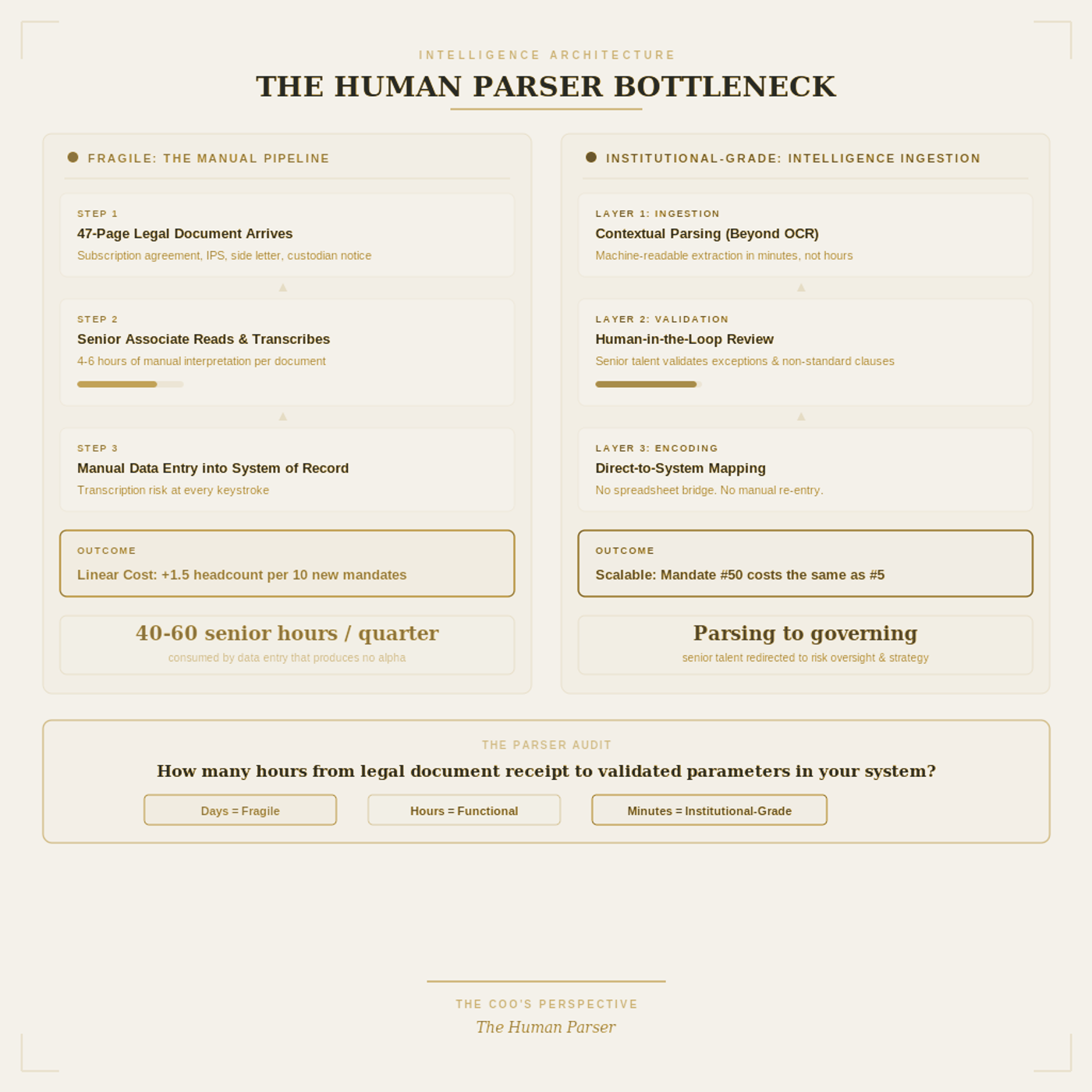
If your ability to scale is limited by how many PDFs, emails, and spreadsheets your team can read in an hour, you don't have a workflow—you have a Human-Parser bottleneck.
Last week, we established the need for an Exception Delta of under 120 minutes. But the primary fuel for the Batch Death Spiral isn't just slow systems; it's unstructured data. Even with high-velocity APIs, the "last mile" of exception management often involves a human translating a custodian's email or complex notice into your System of Record.
THE DEFINITION: A Human-Parser is any workflow where an associate must read an unstructured document (e.g., a subscription agreement, a side letter, a custodian notice) and manually transcribe its parameters. This isn't a support function; it is a load-bearing wall in your data architecture that creates a linear cost function: every new mandate requires a proportional increase in senior hours.
THE COST OF HUMAN LATENCY The Exception Delta isn't just a system lag; it is a cognitive lag.
- The Manual Reality: A 47-page subscription agreement includes capital call schedules and bespoke side-letter carve-outs. Parsing this takes 4 to 6 hours.
- The Scaling Cliff: At 10 new mandates a quarter, a Fragile firm adds 1.5 headcount just to keep pace.
- Institutional-Grade Scale: Volume is decoupled from headcount through Intelligence Ingestion.
BEYOND OCR: UNDERSTANDING CONTEXT Modernizing the middle office requires a shift from Pull to Push: from "searching for text" to "receiving intelligence." We call this Generative Parsing.
- The OCR Way (Legacy "Pull"): OCR reads "15 days" and enters it into a spreadsheet. A human must still "pull" the meaning: Is this a notice period, a liquidity gate, or a reporting deadline?
- The Contextual Way (Intelligence "Push"): The system recognizes the "Most Favored Nation" clause in a side letter, understands the context, and "pushes" the fee-adjustment exception directly to the Validation Engine for approval.
INTELLIGENCE INGESTION Generative Parsing provides the structured data layer modern architectures require. Without this automated "sight," your system is flying blind. By converting unstructured documents into real-time intelligence, you create the foundation for Agentic AI—the layer that not only surfaces data but acts on it.
The hallmark of a Functional firm is using senior talent to fix manual breaks. The hallmark of an Institutional-Grade firm is using technology to eliminate the break before it reaches a human.
If your architecture requires a Human-Parser, it is a ceiling on your AUM.
📊 THE INTELLIGENCE AUDIT: In Volume 2 of "THE INSTITUTIONAL ARCHITECT," I break down how to replace manual parsing with event-driven intelligence.
Access it here: https://lnkd.in/eBSuvMhb
NEXT WEEK: Agentic AI: The difference between AI that answers and AI that solves.
#AssetManagement #OperationalExcellence #FinTech #AIinFinanceå<img src="media/image1.png" style="width:6.25in;height:6.25in" />
Want the diagnostic frameworks behind these notes?