Agentic AI
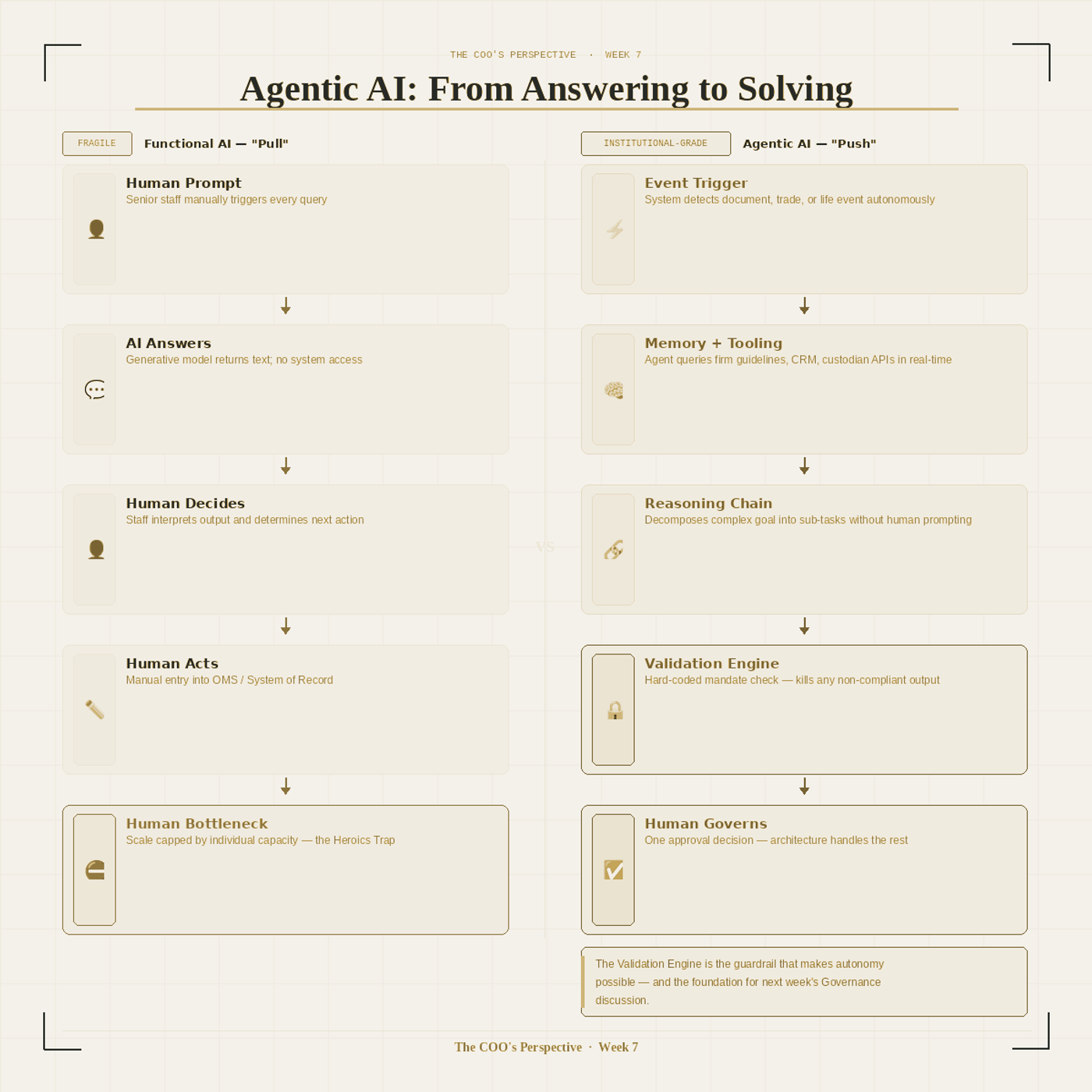
Most firms treat AI as a high-end search engine for "asking questions." But in an Institutional-Grade architecture, AI isn't a research tool; it's an operator. While Generative Parsing provides the structured data layer, Agentic AI provides the execution layer, moving from manual "Pull" workflows to autonomous "Push" systems.
THE "AGENTIC STACK" To move beyond a chatbot, your architecture must provide three non-negotiables:
- Context Engine: A specialized repository that grounds the AI in your firm’s investment guidelines and client-specific preferences to prevent hallucinations.
- Tooling: Secure API connections to your accounting engine, CRM, and custodian portals.
- Reasoning Chains: The ability to decompose a complex goal (e.g., "Onboard this UHNW client") into 20 distinct sub-tasks across systems without human prompting.
ADOPTION REALISM: THE SCALING GAP Wolters Kluwer's 2025 survey projects 44% of finance teams using agentic AI by 2026 (a 600%+ surge from 6% current levels). Yet, as noted by Azilen, few have achieved true scale. The bottleneck isn't capability; it’s Trust. How do you let an Agent “act”? You separate the "inference" from the "rule":
- Probabilistic (The AI): The Agent suggests the optimal path based on its training.
- Deterministic (The Guardrail): The output is run through a hard-coded Validation Engine (see Week 4). If a suggestion violates a mandate, the system kills the process.
This "Agent-plus-Engine" model is the only way to achieve Institutional-Grade autonomy.
THE USE CASES OF THE INSTITUTIONAL AGENT
- Private Credit: The Agent parses covenants across a 47-page Credit Agreement, identifies non-standard LIBOR-to-SOFR transitions, and stages the record update for review.
- Wealth Management: Detects liquidity events, cross-references IPS concentration limits and tax-loss harvesting windows, and prepares compliant rebalancing trade tickets for advisor sign-off—compressing four hours of work into minutes.
FROM "FUNCTIONAL" TO "AUTONOMOUS" A Functional firm uses AI to help people work faster. An Institutional-Grade firm uses AI to perform the work, shifting people from "Doers" to "Governors."
If your AI strategy relies on individual prompts rather than autonomous reasoning chains, you haven't built an agent; you’ve simply added a new interface to a legacy workflow.
📊 THE AGENTIC BLUEPRINT: In Volume 2 of “THE INSTITUTIONAL ARCHITECT,” I break down the specific tech stack (Context, Tooling, and Governance) required for autonomous operations.
Access it here: https://lnkd.in/eBSuvMhb
NEXT WEEK: The Governance Gap — How to trust a system that thinks for itself.
#TPlus1 #AgenticAI #WealthManagement #AssetManagement #OperationalExcellence #FinTech #PrivateCredit #AIinFinance
<span class="mark">First Comment:</span>
For those looking to verify the adoption benchmarks mentioned above:
📊 The 44% Adoption Metric: Based on the Wolters Kluwer 2025/2026 Finance Leader Survey (https://www.wolterskluwer.com/en/news/pr-2025-wolters-kluwer-survey-increasing-adoption-agentic-ai), which tracked a massive surge from 6% current usage to 44% projected utilization by 2026.
🏗️ The Scaling Gap: Insights on the shift from "experimentation to execution" and the architectural bottlenecks (Integration and Data Quality) are detailed in the Azilen 2026 Definitive Guide to Agentic AI in Finance (https://www.azilen.com/blog/agentic-ai-in-financial-services/).
As the data shows, the window for "pilots" is closing. Success in 2026 is defined by how well you can move your agents into a Deterministic production environment.
Want the diagnostic frameworks behind these notes?