Active Incident Response
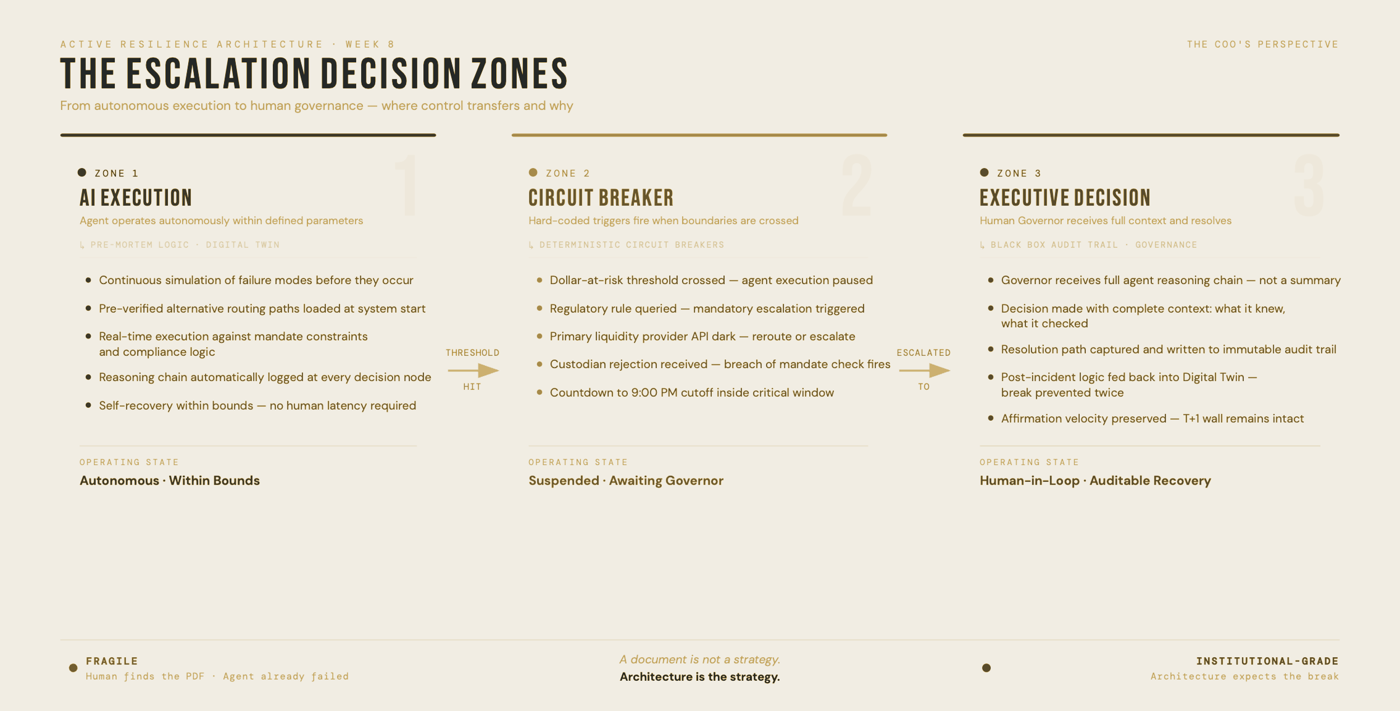
In Week 7, we discussed Agentic AI, shifting from "answering" to "solving." But as you increase autonomy and velocity, you must re-engineer your safety net. You cannot run a 2026 Agentic Stack on a 2015 "Incident Response" plan.
Most institutional recovery plans are essentially "Compliance Theater." They assume a world where you have hours to convene a committee. But in a T+1 environment, where an Agent executes at machine speed, a document is not a strategy. Institutional-Grade resilience requires a transition from passive documentation to an Active Response Architecture.
THE T+1 PRESSURE COOKER T+1 has eliminated the "buffer of human error." Consider a 3:50 PM scenario: Your autonomous Agent encounters a corrupted feed or custodian rejection while closing a trade. The bottleneck isn't the technical fix; it is decision-making latency. If the response relies on a human finding a PDF to identify the escalation path, the Agent’s recovery window has already closed.
THE THREE PILLARS OF ACTIVE RESILIENCE
To bridge the gap between "Compliance" and "Execution," your architecture must be as intelligent as the agents it oversees.
- Pre-Mortem Logic (The "Digital Twin"): Resilience begins before the break. Instead of waiting for failure, your system should run simulations of agentic failure modes. If an API goes dark, does your system automatically trigger the pre-verified routing path, or does the Agent simply stall, waiting for a human decision that has no clear trigger?
- Deterministic Circuit Breakers: Autonomous agents require hard-coded boundaries. You need triggers that move an incident from "AI Execution" to "Executive Decision" the moment a dollar-at-risk threshold is crossed, or a regulatory rule is queried. Resilience is defined by how fast you can return control to a human Governor.
- The "Black Box" Audit Trail: An incident is only a failure if the Reasoning Chain is lost. Your platform must capture what the agent "knew," which guidelines it checked, and why it chose a recovery path. This isn’t just for regulators—it’s the data you need to ensure the break never happens twice.
BEING RESILIENT BY DESIGN A Functional firm survives through individual heroics. An Institutional-Grade firm survives through an architecture built to withstand the break. If your plan requires a human to open a file to find "next steps" while agents are running, you don't have a resilient platform—you have a systemic risk.
📊 THE INTELLIGENCE BLUEPRINT: In Volume 2 of “THE INSTITUTIONAL ARCHITECT,” I break down the Agentic Stack and the data integrity required for autonomous operations.
Access it here: https://lnkd.in/eBSuvMhb
NEXT WEEK: The SPOF Audit — Identifying the single points of failure in your autonomous architecture.
#IncidentResponse #AgenticAI #OperationalExcellence #AssetManagement #COO #Resilience #FinOps
Want the diagnostic frameworks behind these notes?