The SPOF Audit
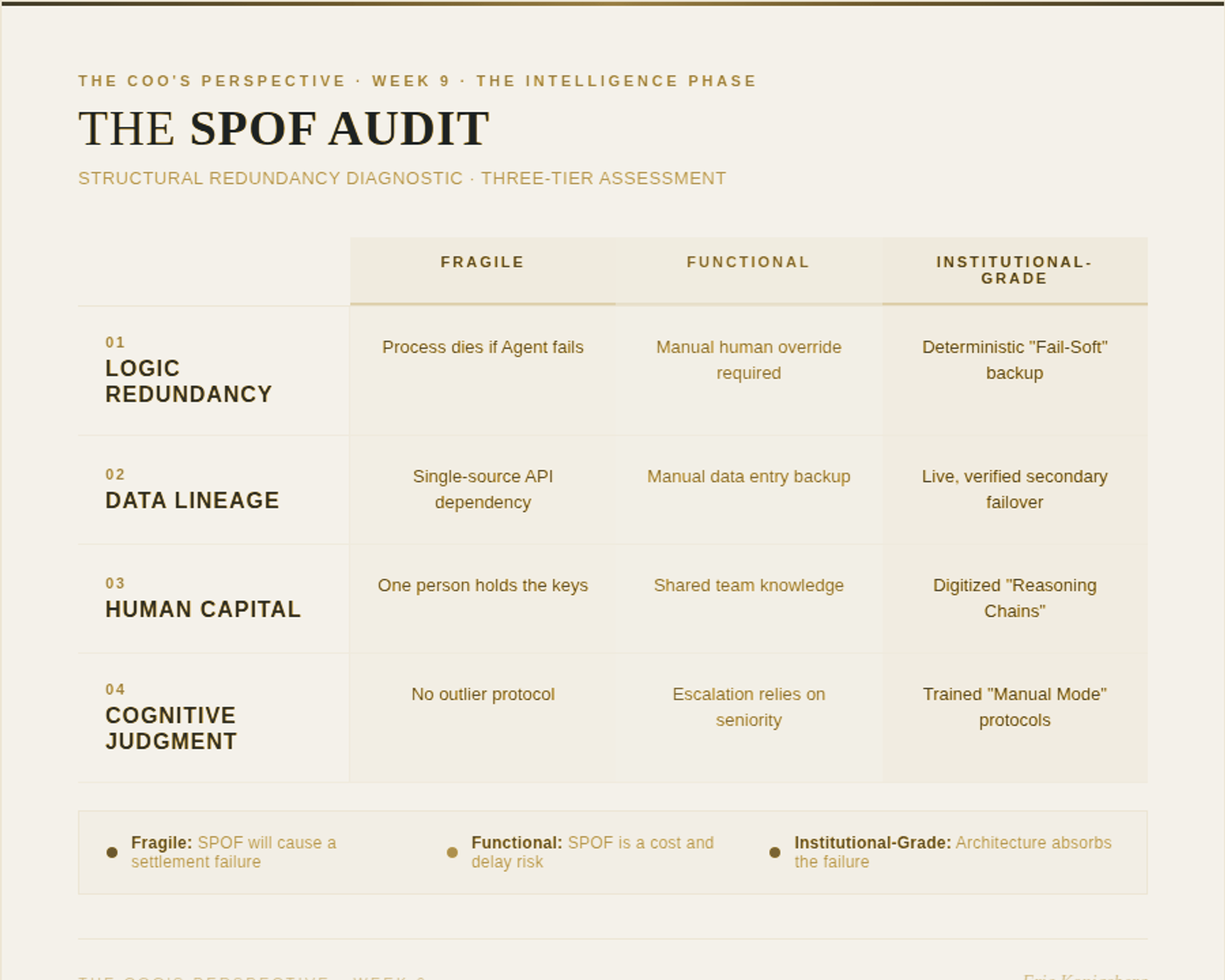
In Week 8, we discussed Active Incident Response. But a response architecture is only as strong as its weakest link. In a high-velocity, T+1 environment, Single Points of Failure (SPOFs) are no longer just hardware issues—they are embedded in your workflows.
THE EROSION OF THE TIME BUFFER
In a T+2 cycle, a SPOF was a nuisance; you had 48 hours to find the manual fix. In T+1, that same SPOF is a catastrophe. When the settlement window shrinks, your "architectural debt" is called due. You can no longer afford a dependency that requires a manual override to survive the 4:00 PM cutoff.
FROM CHOKE POINTS TO ARCHITECTURAL SOLUTIONS
The dangerous SPOFs are hidden in processes that appear automated but rely on invisible dependencies. To move from Fragile to Institutional-Grade, you must replace these choke points with Governor Logic.
1\. The Data Pipeline Bottleneck
- The SPOF: A single API feed. If that feed jitters, every downstream agent begins making decisions based on stale data—syncing "two copies of a lie."
- The Solution: Active Cross-Polling. Moving to Logical Redundancy by running real-time reconciliations between independent "Sources of Truth" (Custodian vs. Market Data) before the data propagates.
2\. The Key-Person Logic Gap
- The SPOF: A custom reconciliation that only one person understands. If they are offline during a 3:50 PM break, the "automated" stack stalls.
- The Solution: Deterministic Circuit Breakers. Hard-coding confidence-score thresholds that automatically "trip" and revert the system to a pre-verified Safe Mode when the logic encounters an outlier.
3\. The Cognitive SPOF (Judgment Atrophy)
- The SPOF: Relying on a "human backup" who has become a passive observer of the machine. If they lack the context of the machine's last 1,000 actions, they cannot step in during a crisis.
- The Solution: Digitized Reasoning Chains. Requiring AI Agents to record the "why" of every decision in human-readable logs, ensuring your team retains the cognitive infrastructure to handle machine outliers.
THE ARCHITECT’S MANDATE
A Functional firm identifies a SPOF after it causes a crash. An Institutional-Grade firm maps them into the architecture and builds "Circuit Breakers" to bypass them.
If your firm’s ability to settle a trade depends on one specific person being at their desk or one specific API being 100% up, you haven't built a platform—you've built a fragile chain.
📊 LAUNCHING THE RESILIENCE PHASE: This week marks the final stage of our 90-Day Blueprint. In Volume 3 of “THE INSTITUTIONAL ARCHITECT,” I provide the full 10-point SPOF Audit and the framework for building a "Fail-Soft" operational stack.
Access Volume 3 here: https://lnkd.in/eBSuvMhb
NEXT WEEK: Bespoke Scaling: How to manage multi-billion-dollar complexity without growing headcount.
#TPlus1 #Operations #AssetManagement #RiskArchitecture #SPOF #InstitutionalArchitect #Scale
Want the diagnostic frameworks behind these notes?